Assemblywoman Mary Pat Angelini, R-Monmouth, said she will introduce legislation that will make it illegal to grow and harvest medical marijuana on preserved farmland. On Thursday, the State Agriculture Department Committee (SADC) released a statement indicating medical marijuana is considered an agricultural crop and could be grown on a preserved farm after the issue was raised by residents of Upper Freehold Township.
SADC’s stated position on the matter is not considered to be an action by the committee, which could be vetoed by Governor Christie.
“As I have previously stated, the implications of the medical marijuana law will be far-reaching, and the statement issued by the SADC on Thursday is a prime example,” said Angelini. “The federal government says marijuana is illegal while we have a state statute that would permit its growth on protected farmland. A community that has focused on preserving open space should not have their efforts countermanded. We are experiencing many twists and turns as to how this law will be executed.
“I believe Upper Freehold Township has raised an important public policy question that is a by-product of the new law,” continued Angelini, who serves as executive director of a nonprofit agency that provides substance abuse prevention programs to youth in Monmouth County. “This legislation will ensure that a municipality’s goal to preserve and protect open space can be achieved and maintained and that we continue to make every effort to control how medical marijuana is manufactured.”
Why former Louisiana Governor Buddy Roemer requested to meet the Bayshore Tea Party Group yesterday remains a mystery. If he wanted money, he never asked for it. He touted the fact that he won’t accept donations over $100, and that his average donation is $55, but he never asked. He boasted that he’s raised “a third of a million dollars.”
Asked why he was spending a Saturday in December in New Jersey rather than Iowa or New Hamsphire, Roemer responded, “I’m not in Iowa because it costs $2 million to compete there and I don’t have $2 million. I am in New Hampshire. A lot of people are going to be surprised by my showing in New Hampshire.”
Roemer’s conservative yet populist message would seem to be a perfect fit for the Tea Party crowd. But Roemer clearly wasn’t prepared to be questioned by the group of 20 Tea Party members who are obviously as well informed as they are passionate. He got himself in trouble with the group while embracing the Occupy Wall Street slogan of 1% vs 99% while decrying the influence of money in the presidential campaign. A debate ensued which devolved into bickering over whether or not corporations are people. A Tea Partier arguing that corporations are shareholders, employees and customers. Roemer arguing that a corporation has never been drafted into the military.
No one born after 1957 has been drafted into the military either.
Roemer eventually backed off the 1% vs. 99% slogan, apologizing for “using the language of the day” to make a point.
Roemer said he was competing for the GOP nomination, while acknowledging that he has been in touch with Americans Elect 2012 about a third party candidacy. That didn’t sit well with his audience either, who were concerned about a third party candidate helping President Obama get reelected and about Americans Elect’s funding from special interests. Roemer acknowledged that he hadn’t vetted Americans Elect prior to allowing his name to be attached to the group.
The former governor and congressman was particularly critical of Newt Gingrich, Mitt Romney and Jon Huntsman, decrying the special interests funding their campaigns. He said Huntsman’s father is using legal loopholes to funnel $20 million to his son’s campaign. Roemer really doesn’t like Gingrich, with whom he served in Congress.
“There is no president amongst the current GOP front runners,” Roemer declared. There wasn’t a president at the Bayshore Tea Party Group office either.
At that’s too bad. There is a great deal about Roemer’s core message that is attractive.
He favors a flat tax; 17% of all income for all, individuals and corporations, over the first $50,000 earned. When asked about the fair tax, a national sales tax, Roemer said he could go that way too.
Roemer said he’s a fair trader, not a free trader. He would use tariffs and economic sanctions to bring balance to our relationships with China and Saudi Arabia. Tariffs on all oil importers, except Mexico and Canada, as well as the end of subsidies for unproven energy technologies, would be the keys to creating energy independence in a Roemer administration.
On foreign policy, Roemer said American should not be the world’s policeman. That he would emphasize economic sanctions to advance our interests, but would keep a strong military in the background. He was absolute that he would not allow Iran to have nuclear weapons.
Marlboro Councilman Frank LaRocca and businessman Vin Gopal, an Assembly candidate from the 11th legislative district last month, are building their alliances and working the phones. LaRocca is the law partner of Marlboro Mayor Jon Hornick. Gopal, a business partner of Scudiery. Hornick, considered a Democratic rising star statewide, is all in for his political and business partner as they seek to build an organization to propel the young mayor into higher office. Scudiery is officially neutral.
During Scudiery’s two decade tenure as chairman he has fought against the state Democratic organization bringing “outsiders” in to fill appointments in the county. Perhaps the most notable example is the Monmouth Prosecutor’s job in 2005. Acting Governor Richard Codey nominated Essex County resident Luis Valentin to succeed Republican John Kaye who had held the job for 21 years. Scudiery objected, wanting the job to go to Monmouth resident Allan Falk. Scudiery asked State Senator Joe Palaia, a Republican, to block Valentin’s appointment via senatorial courtesy. Palaia stayed out of the Democratic family feud, but Trenton Democrats responded by sending U.S. Senator/gubernatorial candidate Jon Corzine and Congressman Frank Pallone to Airport Plaza to demand that Scudiery step down as chairman. He didn’t.
LaRocca and Hornick, “LaHornicca,” are seen to be allied with the Trenton Democratic establishment. They have strong ties to State Democratic Chairman John Wisniewski. Democratic legal powerhouse, DeCotiis, FitzPatrick and Cole, of Teaneck, are the Marlboro borough attorneys.
Gopal, despite having a statewide network of his own, including a close alliance with Newark Mayor Cory Booker, is seen to represent local interests. During his Assembly campaign he expressed a commitment to building a homegrown Democratic organization.
Alliances in the chairman’s race are breaking along similar lines. Middletown Democratic Chair Joe Caliendo is backing Gopal. Caliendo and Howell Democratic Chair Steve Morlino often align their forces, creating an insurmountable voting block. If that alliance stands, Gopal will likely win.
“LaHornicca” has the support of former Red Bank Mayor Ed McKenna, who challenged Scudiery in 2000. McKenna’s law partner, Michael DuPont is also in the “LaHornicca” camp. DuPont is the treasurer of the New Jersey Turnpike Authority. DeCotiis is the law firm for the Turnpike Authority.
However, the Red Bank Democrats are split. Ed Zipprich, the municipal chairman and a councilman supports Gopal.
Democratic campaign and media consultants Pat Politano, of Union County, and Jon Evans of Morris County, famous in Monmouth County for running Brian Unger’s Long Branch mayoral campaign in 2010, are supporting “LaHornicca.” Politano is closely aligned with former State Democratic Chairman Joe Cryan, a Union County Assemblyman and Undersheriff, and with Cryan’s running mate, Senator Ray Lesniak.
As hard as Gopal and “LaHornicca” are working on building their alliances with current municipal chairs and committee members, most of the voters may not yet be identified. The entire county committee, of both parties, is up for election in the June 5, 2012 primary. The current Monmouth County Democratic Committee has over 400 vacancies. The team that gets candidates to run for those empty seats could control the Monmouth Democratic Organization through June of 2014.
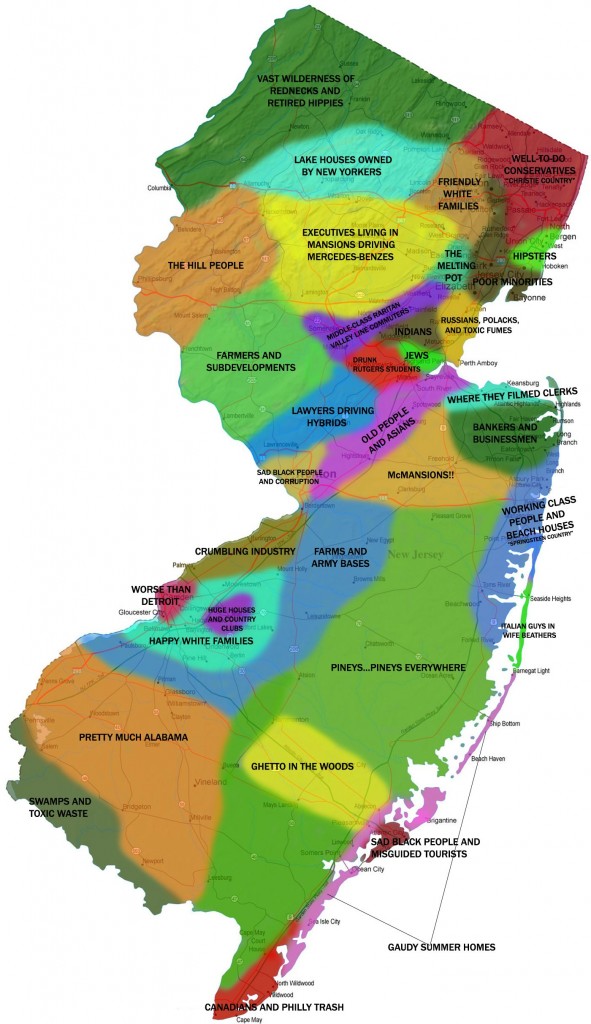
You’ve probably heard about the map that Rutgers grad Joe Steinfeld created on Monday night and posted to his reddit page. By Tuesday night over 750,000 people viewed it on facebook and reddit. The newspapers have all written about it.
Steinfeld was enjoying all the attention until his bosses at the New Jersey Department of Environmental Protection took a dim view of it and released a statement saying it had nothing to do with the department.
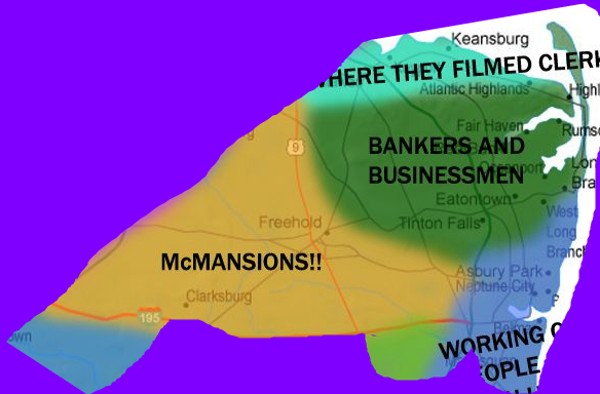
Steinfeld reduced Monmouth County to “WHERE THEY FILMED CLERKS,” BANKERS AND BUSINESSMEN,” WORKING CLASS PEOPLE AND BEACH HOUSES: SPRINGTEEN COUNTRY, ” and “McMANSIONS.”
Obviously, Steinfeld doesn’t know Monmouth all that well. The Bayshore is much more than where Kevin Smith filmed clerks. Coastal Monmouth is extremely diverse, as are the central , western and southern parts of the county.
Just for fun, how would you correct Steinfeld’s map?
I watched the first half hour or so of Jon Corzine’s testimony yesterday, ready to catch him in double speak, as I have before. I am definitely biased. I have not liked the man since the day I met him at the Sea Gulls Nest when he was running for U.S. Senate in the summer of 2000.
The former governor, senator and master of the universe did not disappoint. He blamed the collapse of MF Global on market conditions. He blamed his inability to answer questions on the committee not giving him enough time and the fact that he didn’t have access to MF Global records, noting that he offered to testify voluntarily in January rather than under subpoena yesterday. He painted his willingness to testify, rather than invoke the fifth amendment as his attorneys undoubtedly advised him to do, as a noble gesture rather than another reckless bet on his brilliance.
Corzine said, “I simply don’t know where the money is,” referring to the $1.2 billion in customer cash missing from the MF Global coffers. Of course you don’t know where it is now, I thought, did you know where it was in October?
When asked directly by House Agriculture Committee Chairman Frank Lucas if he had authorized the transfer of customers’ funds, Corzine dodged the question and talked about his intentions. He was obviously well prepared and coached.
I had seen enough, so I thought.
Then I read Capitol Quickies’ account of Commodities Futures Trading Commissioner Jill Sommers’ and bankrupty counsel James Kobak’s testimony which preceded Corzine’s:
Sommers said the Commodity Futures Trading Commission is untangling complicated client accounts and “tens of thousands” of transactions to learn the whereabouts of “every single penny.”
She added that commodity brokerages are barred from using client money for their own investments, and there’s no evidence MF Global did that. If firms do use “segregated” client funds — which they may do for a small number of legally authorized purposes — they should immediately replace the money, she said.
Companies can’t “take money out of a segregated account, invest it, and then return the money … at some later time,” she testified.
Kobak testified that the bankruptcy trustee hasn’t found evidence of illegal activities by MF Global – yet.
“I would say we have suspicions, but we don’t have the knowledge” that client funds were illegally used, he said.
I was willingly rushing to judgement.
Corzine speculated that maybe the money was owed to the firm by other banks or brokerages that hadn’t returned it as agreed. That sounds like wishful thinking, but I wouldn’t put that past some bankers. Hopefully that is that case and the farmers and investors can get their money back as a result of the investigation.
Trenton— Outraged at news that Lower Township will pay out nearly $1 million in terminal leave payments to its employees for unused sick and vacation time, Senator Joe Kyrillos (R- Monmouth/Middlesex), sponsor of legislation to end sick leave payments for public employees, called for terminal leave reform to be completed before the end of the current legislative session.
“Lower Township’s taxpayers are being forced to pay for a needless, wasteful, and unjustifiable benefit that is enjoyed in virtually no other work environment,” said Kyrillos. “While we can negotiate and compromise over the details of a final bill to fix this problem, there should be no debate about the fundamental idea that any future sick leave earned by an employee should not carry cash value. Abandoning the idea that sick leave is for when an employee is sick rather than deferred compensation would be a slap in the face to taxpayers.”
The Press of Atlantic City reports that the Lower Township Council made an emergency appropriation of $900, 000 to fund terminal leave payments for employees this year, including three employees receiving checks in excess of $100, 000. Terminal leave payments are responsible for several cents on the municipal tax rate.
“We cannot allow this to go on any longer,” said Kyrillos. “There is simply no good reason to assign cash value to sick leave that is not used by an employee. Taxpayers are being gouged for no reason other than inaction in Trenton.”
Monmouth Park is in jeopardy of closing due to a dispute over the licensing of thoroughbred races at the Meadowlands, according to a report in The Star Ledger.
The New Jersey Thoroughbred Horsemen’s Associated successfully negotiated for the rights to the Meadowlands races on June 21. Now the investor slated to take over the Meadowlands track, Jeffrey Gural, wants the rights back because he didn’t realize he was giving up proceeds of off-track wagering on the races. Evidently, the Christie administration is siding with Gural and is refusing to issue the license to the horsemen.
The Meadowlands license impacts Monmouth Park because races licensed for the Meadowlands are frequently transferred to Monmouth.
As a result of the dispute, Morris Baily, the investor slated to take over Monmouth Park from the state, says he wants out of the deal, according to the Ledger.
The parties would have a lot more money to fight over, while keeping the tracks open, if slots were permitted at the racetracks, as they are in a growing number of tracks throughout the region.
Assemblyman Ronald Dancer has introduced two pieces of legislation that would permit slots at racetracks.
A-4294 directs the Division of Gaming Enforcement (DGE), in consultation with the New Jersey Racing Commission, to implement and oversee slot machine gambling operations at horse racing venues.
ACR-209 is a resolution proposing a constitutional amendment that gives the Legislature the authority to establish slot machine gambling at racetracks. If approved by voters, the specific restrictions and control of operations of slot machines, as well as the use of the State’s share of revenues derived from the machines, would be provided by law.
“Both proposals represent an incentive for the major stakeholders in this issue – the casino and horse racing industries – to come together and work out a fair and mutually beneficial agreement. Allowing slot machines at racetracks will generate revenues that will help both industries,” said Dancer. “One industry’s success does not have to be at the expense of the other. Permitting slot machines at racing venues will preserve and enhance both.
“One unique aspect of these bills is that the DGE will consult with the Racing Commission in overseeing the operation of slot machines, without the involvement of the New Jersey Lottery Commission which exists currently,” explained Dancer. “As a result, the proceeds from expanding slots at the racetracks would not be diluted to another commission, but distributed to the industries for which they are intended.
I am open to either approach in deciding this issue. We can allow the voters to determine if amending New Jersey’s Constitution is appropriate or work through the legislative process,” commented Dancer. “The casino and horse racing industries are important parts of our state’s economy. I am confident we can reach a reasonable solution as to how we can capitalize on the market potential slot machines at racetracks will produce.”
Dancer pointed out the benefits New Jersey’s horse racing industry provides to the state, including jobs, tax revenue and preserving open space. According to the Rutgers Equine Center, horse racing employs over 7,000 workers and contributes nearly $800 million to the state’s economy. Further, 34,000 acres of the state’s 176,000 farmland acres are attributable to the horse racing industry.
Unfortunately, Dancer’s legislation has little chance of becoming law, as Governor Chris Christie and Senate President Steve Sweeney are opposed to allowing slots in New Jersey anywhere outside of Atlantic City.
Fox Business is reporting that Jon Corzine with not invoke his fifth amendment rights against self incrimination when he testifies before the House Agriculture Committee this morning.
The former U.S. Senator and former New Jersey Governor was chairman of MF Global until his resignation last month following the firm’s bankruptcy filing. $1.2 billion is customers’ funds are missing.
Fox reports that Corzine will read a 21 page statement to the House committee which will include an apology and a denial that he knows where the $1.2 million went.
~ Lewis Eisenberg referring to State Senator Joe Kyrillos
While introducing keynote speaker Governor Chris Christie to the Republican Jewish Coalition Presidential Candidates Forum this morning, Lewis Eisenberg, the group’s chairman, gave a shout out to State Senator Joe Kyrillos as “the next senator from the state of New Jersey,” according to Herb Jackson at northjersey.com.
While in Washington with Christie, Kyrillos told The Hill,
“I am looking at it really closely,” Kyrillos said Wednesday in a brief interview with The Hill. “I feel a strong calling.”
Kyrillos does not have endorsements from Eisenberg or Christie, for past work, past runs for office, or for U.S. Senate, listed on his website.