Politickernj writers Darryl Isherwood and Max Pizarro posted an in depth piece yesterday afternoon that exposes an incestuous web of influence driving planning, zoning and development approvals before the Middlesex County Freeholder Board and several municipal planning boards in the county.
State Senator Bob Smith of Piscataway is the leader of the PACs that fund the campaigns of the Freeholders and municipal officials who approve the applications. The applicants are donors to the PACs. Smith is the applicants’ attorney.
It’s all legal. And no one would know about it if not for Harold Kane of Monroe Township painstakingly examining thousands of pages of ELEC reports to find out where all the Middlesex Democratic money was coming from and the good journalists at Politickernj and The Star Ledger following the money.
Smith, the Senator working the system, and Peter Barnes, the Assemblyman and Middlesex County Democratic Chairman who’s candidates benefit from the system, know the solution to this “craziness.” Barnes said that “any impetus to close the hole lies with the legislature.” Smith said, “There is a solution to the craziness we have now and that is publicly financed elections – or complete transparency. “In New Jersey, we have nothing but chaos. The state needs one set standard across the state.”
Where is their legislation? Smith and Barnes are both powerful members of the legislature. They obviously know how the work the system. They know how to fix it.
Here’s a campaign finance system that would be transparent:
1) Remove all limits on campaign contributions.
2) Require that all candidates and campaigns disclose all contributions of any amount on a dedicated website within 24 hours of receipt.
3) Competing campaigns, good citizens like Kane, and good journalist will examine the donations and expose influence. Voters will decide if the influence is acceptable of not.
Correction: Peter Barnes, Jr, the Middlesex Democratic Chairman is no longer in the legislature. His son, Peter III is an Assemblyman.
Now there are two Barnes and a Smith who can advocate for legislation that creates complete transparency.
Which poll is closer to reality? Quinnipiac or Monmouth?
How two respected independent pollsters could have such differing results for Governor Chris Christie’s approval ratings has been the subject of quite a bit of chatter this week since Monmouth University released their poll indicating that Christie’s ratings were 11 points lower than reported by the Qunnipiac poll released last week. Quinnipiac reported Chrisite’s approval rating at 59%-36% while Monmouth said that 50% of registered voters approve of the job that Christie’s doing compared to 38% who do not.
There’s been enough buzz about the difference that Patrick Murray, Polling Director at Monmouth, posted a piece on his blog (cross posted on Politickernj), that took a swipe at Quinnipiac for framing their approval question in such a way that Christie’s numbers would be higher. Murray said that because Quinnipiac first asked if Christie would be a good selection as a Vice Presidential nominee, respondents were more likely to give him higher marks when asked to evaluate his job performance.
Quinnipiac, on the other hand plays around with the order in which they ask the governor’s job rating question.In 8 polls over the past year, they asked Gov. Christie’s job rating as the first question in 3 cases and the 3rd question in one case.For the remaining four polls, the governor’s rating question was slotted from #10 and #13 in their questionnaire.
When it was the first question, the governor’s positive job rating was only 44% to 47%.At the number 3 slot, it was 53%.At #10 or later in the interview, it ranged from 55% to 59%. It’s worth noting that the lower poll numbers came early last year, and were either closer to or even lower than other polls conducted at that time. Hmmm.
In the most recent Quinnipiac poll, one of the questions preceding Gov. Christie’s rating presented him as a potential nominee for Vice President.In other words, the survey framed the governor as a national figure before asking voters to rate his job performance.Could this be why his rating among Republican voters in particular shot up to an astronomical 92%?
Pollsters know that job approval ratings can be impacted by the context of a poll interview.That’s why most pollsters try to place these key trend questions in the same place in every questionnaire.This increases our confidence that any changes in a politician’s ratings are due to real shifts in opinion and not an artifact of questionnaire inconsistencies.
I’m willing to venture that first naming Chris Christie as Mitt Romney’s potential running mate before asking New Jerseyans to rate their governor might have had a wee bit to do with the two polls’ divergent trends.
Mickey Carroll, Director of the Quinnipac Polling Institute, is not interested in getting into a pissing match with Murray. “Patrick Murray is a very good pollster,” Carroll said three times in a seven minute phone interview with MMM. “Every poll is different, something could have happened in the week in between the two polls,” Carroll said, “we asked the question the same way.”
When told that Murray said that Quinnipiac framed the approval question by first asking a question about Christie being a potential VP, Carroll said, “that could make a difference, but I think we asked the approval question first. Didn’t we? Patrick Murray is a good pollster, a savvy analyst and a smart guy.”
Republican strategists, who would only speak on background, were quick to criticise Murray and side with Quinnipiac.
“The Quinnipiac poll from last week showing the Governor’s job approval at 59% is closer to reality,” said one strategist who cited internal GOP numbers, “The problem with the Monmouth University poll is that it samples, ADULTS, rather than registered voters, or better still, likely voters.It is cheaper and easier to poll adults, because thereare a lot more of them and they are easier to qualify.It is harder, and more expensive, to find and poll a likely voter – especially a likely voter who votes in non-Presidential year elections.”
When told that Murray blamed the difference on how Quinnipiac framed the question, the same strategist said, “Patrick is out of his mind.”
In fairness to Murray, MMM verified that Quinnipiac and Monmouth both sample adults who then self identify as registered voters. However, on their website Quinnipiac says that they ask screening questions, plural, to determine who is a registered voter. Murray said Monmouth only asks one question to determine if a respondent is registered to vote or not. He said that 80% of his respondents tend to be voters. 78% of New Jersey adults are registered to vote.
In his blog post, Murray acknowledged that his Monmouth poll results are consistently more favorable to Democrats while Quinnipiac’s are consistently more favorable to Republicans. MMM asked Murray how that could happen consistently if both polls were using random computer generated phone numbers. “Is it how you weight the sample?” we asked. “That’s part of it,” Murray said, “the rest is that we (Monmouth) call a greater percentage of cell phones. Cell phone users tend to be younger and more Democratic.”
With that answer, that weighting his samples more heavily towards Democrats and cell phone users, Murray seemed to be confirming the Republican complaints.
“That’s fine, I’m the only one who consistently asks the trend question in the same place,” was Murray’s retort, “that’s polling 101.”
Another Republican strategist was more upset about how Murray wrote up his poll release that he was with the numbers. “Political sands are shifting?” asked the Republican.“It’s a margin of error shift!Murray sounds like he is writing press releases for the Democratic State Committee, not acting as an independent pollster from an esteemed New Jersey university.”
A third Republican scoffed at the notion of even taking Murray’s numbers seriously, pointing out how badly Monmouth Gannett polled the 2009 gubernatorial race between Chrisite, former Governor Jon Corzine and Chris Daggett. “Murray’s last poll in that election had Corzine winning by 2 points and Daggett getting 8% of the vote. Christie won by 5 points a few days later.”
MMM set out to find a Democratic strategist to weigh in on the difference between the two polls, but no one would talk to us. “Try Patrick Murray,” was the best answer we got.
UPDATE
Murray called shortly after this piece was posted to ask that if his 2009 gubernatorial results were going to be used against him, that his correct calling of the 2010 CD-6 congressional race also be mentioned.
During the 2010 congressional race, MMM analysed a Monmouth Poll that indicated Congressman Frank Pallone was leading Anna Little by 11%. MMM concluded, using Monmouth’s data, that Pallone’s lead should be 9%. Murray agreed, “your turnout assumptions are as good as mine,” he said. Things got funky when the Little campaign issued a press release announcing that Murray had revised his numbers based upon MMM’s analysis and that Pallone’s lead was then in single digits. Murray issued a release stating that his “official” numbers hadn’t changed. He issued a later poll that indicated Pallone’s lead was down to 7% and in the final days of the campaign said a Little victory “could well happen.”
When Pallone eventually won by 11%, Murray said he was right all along.
It was all great fun for MMM, except that Murray stopped taking our calls for a while.
In his call this afternoon, Murray reiterated that the primary difference between the recent Quinnipiac poll and his poll about Christie’s approval ratings, is that Quinnipiac changed their methodology by altering the order of the questions.
Regarding polling adults vs polling registered voters, Murray said he was not in the business of electing or reelecting any candidate. He said his job is to report on what New Jersey residents are thinking.
Murray also said that his “poltical sands are shifting” comment in the poll release was a reference to New Jersey Democrats who being more aggressive in how than they go after Christie than they have been in the past. It was not a reference to the public’s approval of Christie, he said.
Karin McQuillan, a retired psychotherapist and author who served in the Peace Corps in Senegal, writes at American Thinker that Hillary Rosen’s recent rant that Ann Romey never worked a day he her life is part of the Obama political strategy rooted in the politics of envy. Worse, she says the strategy is deeply rooted in Obama’s psyche as a result of his upbringing.
Closer to home, our friends at InTheLobby have a hilarious account of how Port Authority Deputy Executive Director Bill Baroni turned the table on U.S. Senator Frank Lautenberg during the senator’s hearing this week over the fairness of toll increases and patronage at PA.
Turns out that Lautenberg as a former commissioner of the PA he had a free EZ pass for decades and didn’t pay tolls from 1978 through 2006 when the PA stopped issuing free EZ passes to cronies.
Regarding patronage, a former Lautenberg campaign staffer joined PA in 2002, and U.S. Senator Bob Menendez’s son is an intern at PA now.
West Virginia U.S. Senator Jay Rockefeller came to Lautenberg’s defense. New Jersey Democrats have been silent, just as they were during Lautenberg’s dust up with State Senate President Steve Sweeney and George Norcross over the Rutgers-Rowan merger earlier this month.
Signs Executive Order to Form Interagency Council on Homelessness and Develop Ten-Year Plan
Trenton, NJ – Today, Governor Chris Christie signed Executive Order 92 creating the Interagency Council on Homelessness to combat homelessness as part of the Administration’s commitment to protecting the most vulnerable New Jerseyans. The Council is tasked with better identifying and addressing the needs of homeless New Jerseyans as part of a longterm plan to help assist those individuals affected by homelessness and to prevent homelessness from taking hold in the future. This cooperation and planning will strengthen existing efforts by improving the coordination and delivery of programs and services to those in need.
Governor Christie signed Executive Order 92 at HomeFront in Ewing, an organization that works to combat homelessness by increasing the availability of adequate, affordable housing for New Jersey families in need of assistance. The Governor was joined by Department of Human Services (DHS) Commissioner Jennifer Velez and Deputy Commissioner of Community Affairs (DCA) Charles Richman. The Council will be co-chaired by the commissioners of DHS and DCA.
“Homelessness in our society often touches each of our communities in a personal way and too often fails to get the attention it deserves. It is our neighbors, friends and sometimes family members who, having fallen on difficult times, struggle to have their basic housing needs met,” said Governor Christie. “Right now, New Jersey has a strong set of services available to assist our homeless residents get back on their feet, but they are not applied in a strategic and coordinated way. We can do better to serve families who need help now, and deliver services in a more organized way to prevent homelessness from occurring in the first place.”
According to a January 2012 report from the National Alliance to End Homelessness, New Jersey’s rate of chronic homelessness has decreased by 20 percent, indicating progress in identifying and working with individuals with substance use disorders, disabilities, mental illness or medical issues. However, overall homelessness has increased over that same period (7%), which means there is still work to be done to support families and veterans.
“Without a place to call home, it’s incredibly difficult to secure and retain a job or nurture a family,” said Human Services Commissioner Jennifer Velez. “Safe, permanent housing truly is a key factor in helping people attain self sufficiency.”
Governor Christie’s Fiscal Year 2013 Budget proposal acts on a commitment to provide housing assistance for New Jerseyans who are in need. In addition to providing $2.3 million to expand the successful Veteran’s Haven – the veterans transitional housing program – to the northern part of the state, Governor Christie’s budget provides critical funding for housing assistance programs such as the State Rental Assistance Program ($21 million), the Homelessness Prevention Program ($4.4 million), and Shelter Assistance ($2.3 million).
In addition, the Department of Human Services serves many homeless residents through its General Assistance and Temporary Assistance for Needy Families (TANF) programs. Both provide supports that include temporary shelter placement, rental assistance, medical coverage, food assistance and job training. The Governor’s Fiscal Year 2013 Budget protects $78.6 million in funding for the WorkFirst New Jersey program, which helps people get off welfare, secure employment and become self-sufficient through job training, education and work activities. Other state services also are provided to homeless individuals who have mental health or addiction disorders.
These programs have helped make New Jersey a leader in preventing chronic homelessness in New Jersey, but homelessness continues to affect too many New Jersey families. The Governor’s action today will mobilize the state government in a more efficient, coordinated and strategic manner around the goal of finally ending homelessness in the state.
“Today, we are taking action to more effectively address the needs of homeless New Jerseyans across every aspect of state government, with the goal of identifying and preventing the many different causes of homelessness. Ultimately, I believe that as leaders we must set high, achievable goals for the serious challenges we face, which is why the Council also will be charged with developing a 10-year plan to combat homeless over the long-term,” added Governor Christie.
The Interagency Council on Homelessness will be established within the Department of Human Services, be comprised of 15 public members, and operate until December 31, 2014. Its duties and responsibilities include:
·A review of the findings contained in the Interim Report of the Council on Preventing and Reducing Homelessness;
·Identifying and evaluating the statutory and regulatory impediments to the effective delivery of services to homeless individuals and families;
·Providing recommendations to improve relevant laws, programs and policies to better utilize state resources directed to homelessness and homelessness prevention;
·Preparing a 10-year plan to end homelessness in New Jersey; and,
·Reporting annually to the Governor on the Council’s work and progress.
The Council’s membership will be comprised of the Commissioners of the following Departments: Children and Families; Community Affairs; Corrections; Education; Health and Senior Services; Human Services; Labor and Workforce Development as well as the Executive Director of the New Jersey Housing and Mortgage Finance Agency; Chairman of the State Parole Board, the Adjutant General and a representative from the Governor’s Office.
Eleven public members will be appointed by the Governor and will include a representative of county government; a representative of municipal government; one person who is or recently was homeless; a representative of the private sector; four representatives of non-profit agencies providing housing, social, behavioral health, or health-care services to homeless individuals or families; a representative from a non-profit providing statewide coverage, technical assistance, and affiliation with a national non-profit; a representative of public housing authorities; and, one representative from the faith based community.
In addition, the President of the Senate, the Speaker of the Assembly, the Senate Minority Leader, and the Assembly Minority Leader each may appoint a member of the Legislature, or his or her designee, to serve on the Council.
Marlboro and Neptune Township held school board elections yesterday. Of the 45,035 registered voters in the the two townships, 2,618 voted.
By far most of those voters were from Marlboro, where over 2000 people came out. In Neptune, less than 600 of aproximately 16,000 registered voters came out.
As of February 18, there was 24,926 registered voters in Marlboro and 15,865 in Neptune Township, according to Labels and Lists. The county website says there were 45, 035 eligible voters in yesterday’s election. Where those 4,244 new voters came from since February could be the subject of a future column. In the meantime GOP leaders should take note that someone seems to be having a voter registration drive in Democratic towns.
For now I’d like to speculate about why there was a close to normal 10% turnout in Marlboro while only 3% turned out in Neptune.
One obvious reason could be competition. In Marlboro, there were 7 candidates for 3 seats on the school board. In Neptune, the 3 seats were not contested.
A not so obvious reason could be campaign spending. In Marlboro one of the candidates, Bonniesue Rosenwald, mailed out a professionally produced post card late last week which included an endorsement from Mayor Jon Hornick. Rosenwald, an incumbent, squeaked out a third place finish by 13 votes to retain her seat.
Some in Marlboro were upset that Rosenwald and Hornick politicised a school board election. I say politicisation increases participation.
With the recent and perennial hubbub about campaign spending and pay to play, few of the critics of the pay to play/PAC/wheeling system are offering alternatives. No one is talking about the public service campaign spending provides.
If not for campaign signs littering our roadways and lawns and mail boxes filled with glossy advertisements few people would know when to interrupt their routines to vote.
With the arguable exception of presidential and gubernatorial elections, the media, local and national, does a horrible job of covering campaigns. The media looks as electioneering as a revenue source, not a story to be covered as if democracy depends upon it.
Current campaign finance laws thwart participation by limiting contributions and making the process more complicated. The process is so complicated that only the most motivated and self interested contribute. Recently, pundits at The Star Ledger, The Asbury Park Press and even the usually smarter than that InTheLobby criticised the John Wisniewski/Middlesex County PAC practices for violating the spirit of campaign finance laws. Hogwash. The complex system that reduces transparency is the spirit of our campaign finance laws.
If our leaders really want to reform the system, rather than give lip service to ethics while voting for a bill with “loopholes” intentionally written in, the would create a simple system with full and immediate disclosure required.
Last election Anna Little proved to be someone that would represent the people and not party politics. She has endured hostile treatment by former supporters that appear to be “party centered” and not concerned with the decay and downward direction of our country.
Recently members of the MCTPC reviewed candidates for congress and the backing they have received and used this as a “beacon of light”. We are very disgusted with the politics and the continued effort of those in both parties to not put forth constitutionally leaning candidates yet these parties swore an oath of allegiance to our U.S. Constitution. Only Anna Little has proven to be for Americans whether they are conservative or the “useful idiots” of the globalists. Therefore we proudly support Anna Little because it is clear Anna Little is not only older, but has proven to be best committed to people’s freedoms and restoring American greatness. She would never say “after this election I can be more flexible“.
Many say “our congress is now leaning more conservative so why bother?” Well this current congress has no clue, they don’t over-ride executive orders, they haven’t de-funded fascist political hidden agendas and have done nothing to audit our federal expenditures. Where is the outrage? It saddens many of us that so many people don’t realize our constitution declares our rights and shouldn’t be looked at as an outdated document. It provides for checks and balances and basic fundamental rights have not diminished due to TV, electricity, computers and the availability of cross state travel.
We put our trust in Anna Little and those folks who are tired and feel it’s not worthwhile to vote. We trust they will see the light and be engaged and await the long hard battle (here we go again) to victory.
Vin Gopal, Candidate for Monmouth County Democratic Chairman in the upcoming June election, has selected State Committeewoman Mary F. Foster as his running mate. Foster, a lifelong Democrat, is a retired retail and textile executive. In addition to being an appointed State Committeewoman, she is also an active county committeewoman as the District 29 female representative in Middletown, representing the district alongside longtime county Democratic Party Chairman Victor Scudiery, who is the male representative for the district. For the past 12 years, Foster has been an elected member of the Middletown Democratic Party Executive Committee, serving as Corresponding Secretary. In recognition of her lifelong dedication to the Democratic Party, Foster was recently selected as a District Delegate to this year’s Democratic National Convention. She will go to Charlotte this summer to cast her vote in support of the Obama/Biden ticket.
“I am excited to join Vin as his running mate and build on the successes that Vic Scudiery built throughout this county. Nobody can fill Vic’s shoes but together we can build on what he has started,” stated Foster.
“Mary Foster will make an outstanding Vice-Chairwoman. She has worked hard for Democrats here in Middletown and is well-respected throughout the Bayshore. Vin’s commitment in challenging Republicans throughout this county is complimented in his choice of Mary Foster,” stated Middletown Democratic Party Chairman Joe Caliendo and Middletown Democratic Club President Don Watson in a joint statement.
“I am honored that Mary has accepted my offer to run on the ticket with me. Together, with so many Democrats around this county, we will continue to fight to elect Democrats at the municipal, county, state and federal levels,” stated Gopal.
Along with her husband Mike, Mary volunteers at her church. She is also involved in other community organizations.
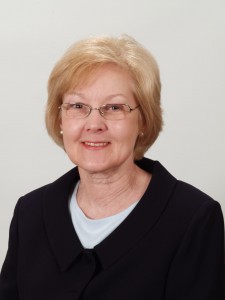
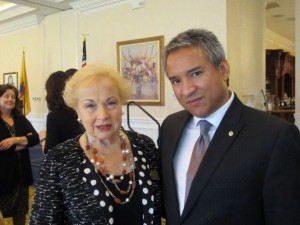
Asbury Park , NJ – 04/17/12 – Ernesto Cullari, candidate for Congress in the 6th District, has received the endorsement of Monmouth County Freeholder Lillian Burry. Lillian believes that Ernesto is the best choice to defeat Frank Pallone this November.
“Ernesto Cullari, albeit new to the political arena, has a sensitivity for what people want from their government. He has a congenial demeanor. Ernesto’s medical background makes him eminently qualified to tackle Obama-Care.” Said Monmouth County Freeholder Lillian Burry
Freeholder Burry, a prolific figure of Monmouth County, has been fighting for the taxpayer on the Freeholder Board since 2005. She was the first woman Director of the Board. Prior to her election as a Freeholder, Ms. Burry was a Mayor, Deputy Mayor, and Committeewoman in Colts Neck. She is also a business owner and broker in her realty firm, Colts Neck Realty.
Cullari and Burry both believe in limited government and personal responsibility. Freeholder Burry spearheaded the 0% tax increase effort in the County Budget in 2008, and has held the line on taxes and spending throughout her tenure. Ernesto Cullari applauds Freeholder Burry for her service to the people of Monmouth County and appreciates her endorsement.
“I am honored to receive the endorsement of Freeholder Burry. She has been a fighter for the people’s interests in Monmouth County while keeping Monmouth County an affordable place to live. Her strong support of our County Park system has made Monmouth County a beautiful place to reside. Freeholder Burry’s endorsement further adds to the list of economic conservatives who have endorsed my candidacy. The coalition we are building to defeat Frank Pallone in November is growing larger by the day.” -Ernesto Cullari
Governor Chris Christie’s approval numbers have slipped 5% since February in a Monmouth University/NJ Press Media poll released this morning.
51% of New Jersey residents approve of the governor’s performance compared to 35% who don’t, according to the poll. Among registered voters, 50% approve of Christie and 38% do not.
In the February Monmouth Poll Christie earned a 52%-38% rating from all NJ residents and 55% to 37% from registered voters.
Today’s Monmouth Poll results are markedly different than the Quinnipiac Poll released last week which indicates that Christie is enjoying his highest approval numbers ever at 59%-36%.
One thing that is consistent between the two polls: New Jersey residents prefer Senate President Sweeney’s property tax relief plan over Governor Christie’s 10% income tax cut.
I don’t have time this morning to study the two polls to account for the difference and it’s too early to call the pollsters for comment. Anyone who can account for the difference in the polls before I get to it is welcome to do so in the comments.
There will be Board of Education elections in Marlboro and Neptune Township tomorrow, April 17th. The rest of Monmouth County school board elections have been moved to the November general election.
Also, April 17th is the last day to register to vote for the municipal non-partisan elections that will take place in Allenhurst, Deal and Keansburg on May 8th.

 Asbury Park , NJ – 04/17/12 –